
26/08/2026
Crystal Growth Techniques and How They Impact Key Optoelectronic Characteristics of Halide Perovskite Crystals
Crystal Growth and Optoelectronic Properties of Halide Perovskites
Crystal-growth conditions strongly influence the structural quality and optoelectronic performance of halide perovskite crystals. Parameters such as precursor composition and purity, solvent environment, temperature profile, supersaturation, growth rate, and crystallization time determine how ions are incorporated into the growing lattice. These factors affect phase purity, crystallographic order, defect density, compositional homogeneity, domain structure, surface quality, and the degree of lattice coherence throughout the crystal. For advanced optical applications, controlling these characteristics is essential. Structural disorder, compositional fluctuations, surface contamination, grain boundaries, and point defects can introduce non-radiative recombination pathways, broaden optical transitions, shorten carrier and exciton lifetimes, and reduce coherence. Conversely, highly ordered crystals with controlled interfaces and low defect densities can support stronger light–matter interactions and more reproducible optical behavior.
Relevance to SUPERLASER
The SUPERLASER project aims to investigate routes towards room-temperature superradiant emission by exploiting the exceptional optical properties of deliberately designed halide perovskite crystalline systems. Superradiance is a cooperative emission process in which a large number of emitters interact coherently, producing enhanced and collective radiative behavior. Achieving and maintaining such cooperative behavior at room temperature is particularly challenging because thermal fluctuations, structural disorder, and local variations in the material can disrupt coherence and reduce the effective alignment and coupling of emissive states.
The development of perovskite crystals with carefully controlled structural order, composition, interfaces, and optical uniformity is therefore central to the project’s scientific objective. Three-dimensional (3D) ordered crystalline architectures may offer a promising platform for controlling the spatial arrangement and interaction of emissive units throughout the material volume. In this context, the relevant objective is not merely to produce high-quality crystals, but to establish reproducible control over structural parameters that govern coherence length, collective coupling, excitonic interactions, emission linewidth, and radiative efficiency.
Why Growth Method Matters
The selected growth method determines key material parameters, including:
- Crystal phase purity and chemical stability
- Stoichiometric and compositional uniformity
- Defect concentration and defect distribution
- Domain size and long-range structural order
- Surface and interface quality
- Layer arrangement and crystallographic registry
- Optical homogeneity, emission linewidth, and non-radiative loss channels
- Reproducibility of crystal morphology and functional properties
These characteristics directly influence the optical coherence and emitter–emitter coupling that may be required for cooperative emission phenomena. Inadequate control of crystal growth can lead to phase segregation, local strain, lattice disorder, impurity incorporation, surface defects, or enhanced non-radiative recombination. Such effects can significantly limit, or suppress, the emergence of the targeted collective optical response. Optimized growth strategies are also important for minimizing surface-related impurities and structural imperfections. Because optical excitation and emission can be strongly affected by surface states, particularly in crystals with a high surface-to-volume contribution or in thin crystalline architectures, reducing contamination and controlling surface termination are necessary steps toward improving radiative performance.
SUPERLASER’s Approach
A central component of the SUPERLASER project is the systematic investigation and comparison of complementary halide-perovskite crystal-growth approaches. This strategy will enable the project team to identify the growth conditions and methodologies most suitable for producing crystals with the structural precision, compositional uniformity, optical quality, and reproducibility required for the targeted cooperative optical phenomena. By varying growth routes and systematically correlating processing conditions with structural and spectroscopic measurements, the project will establish how crystallization conditions affect defect formation, phase stability, lattice order, optical coherence, excitonic behavior, and radiative properties.
This comparative approach is essential both for identifying the material parameters that govern the targeted optical response and for developing robust, reproducible material platforms for future optoelectronic devices. In line with this objective, the SUPERLASER team at NCSR Demokritos, Athens, investigates three complementary crystal-growth methods. The use of multiple approaches provides the experimental flexibility needed to optimize crystal quality for each material composition and structural architecture, while enabling a rigorous assessment of how growth methodology determines the emergence and stability of the desired optical properties.
Crystal Growing Techniques
Solution Temperature Lowering (STL) method
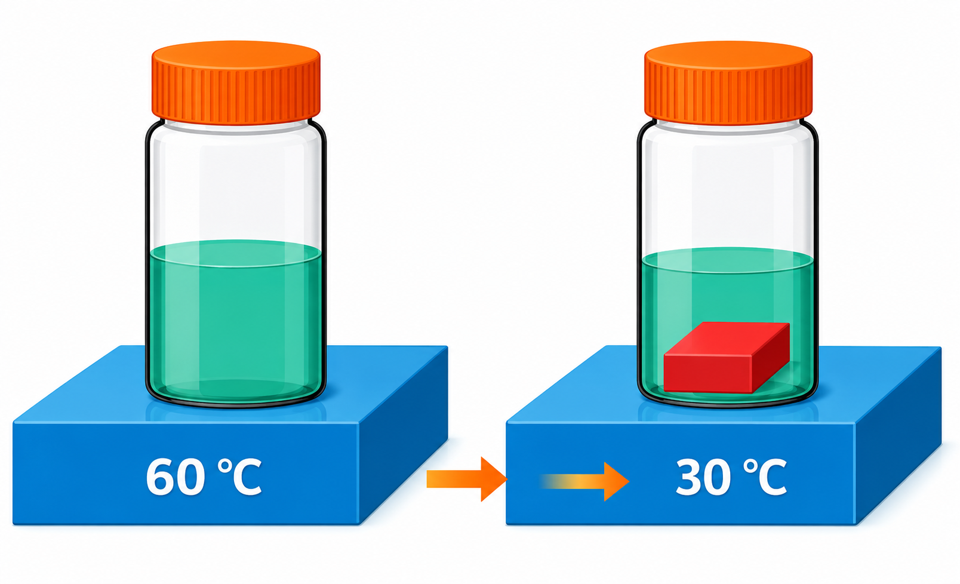
Perovskite precursors, the starting chemical ingredients that react together to form a perovskite crystal, are dissolved into the solvents at a relatively high temperature. Then the temperature of the solution is gradually reduced to reach a supersaturated state which results in the growth of single crystals. A supersaturated state means that the solution now contains more dissolved precursor than it can stably hold at that lower temperature.
This gentle oversaturation encourages the material to come back out of the solution — and when this happens gradually, the atoms organize themselves into well-ordered single crystals rather than random grains. Because the cooling is slow, the atoms have time to arrange themselves neatly, which helps reduce defects and improves the overall quality of the crystal.
Inverse Temperature Crystallization (ITC) method
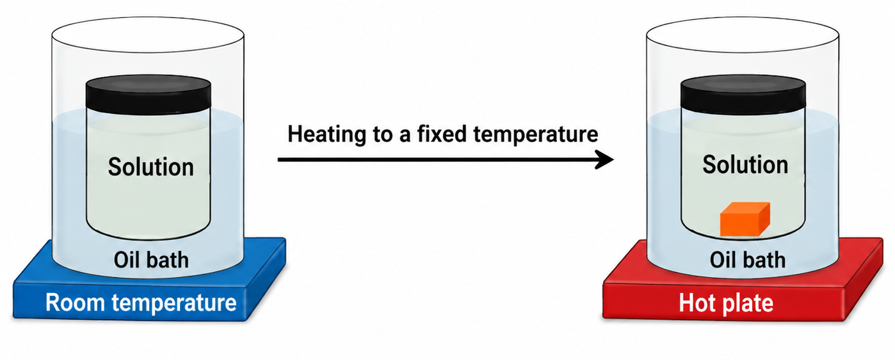
The Inverse Temperature Crystallization method takes advantage of an unusual but very useful property of many perovskite precursor solutions: they become less soluble when heated. This is the opposite of what happens in most chemical systems, where higher temperatures help materials dissolve more easily — hence the name inverse temperature crystallization.
In practice, the perovskite precursors are first dissolved in an appropriate solvent at room temperature, forming a clear solution. The precursor solution is then put into a bottle in an oil bath and heated at a fixed temperature to grow single crystals. Because this supersaturation happens uniformly in a controlled, stable thermal environment, the dissolved ions can organise themselves into single, well-defined crystals. Within minutes to hours, depending on the composition, large and high-quality crystals begin to grow inside the vial.
Antisolvent Vapor Assisted Crystallization (AVC) method
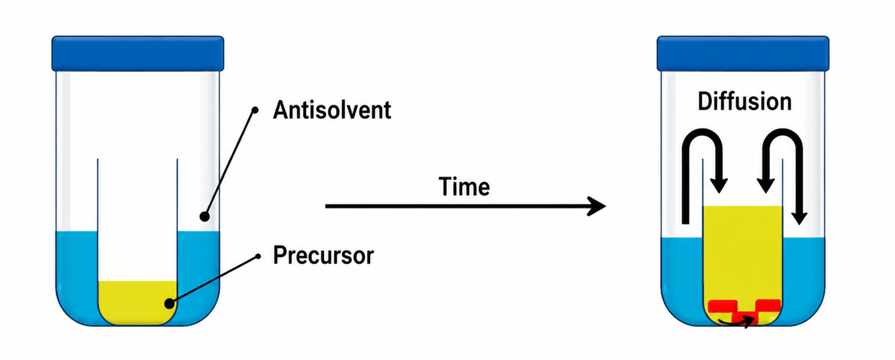
The Antisolvent Vapor Assisted Crystallization method uses differences in solvent compatibility to gently trigger crystal formation. Instead of changing the temperature, this technique relies on carefully controlling how vapors from a second liquid — the antisolvent — diffuse into the precursor solution.
The process begins with the perovskite precursors dissolved in a solvent, in which they are highly soluble. A separate container inside the same sealed chamber holds the antisolvent — a liquid in which the precursors are not very soluble. Over time, vapor from this antisolvent slowly diffuses into the precursor solution. As more antisolvent mixes into the solution, it gradually reduces the solubility of the dissolved precursors. The solution becomes supersaturated in a very controlled and uniform way, allowing atoms to come together and assemble into high-quality single crystals.
Because the process is driven by vapor diffusion rather than heating or cooling, it is largely temperature-independent, making it easy to reproduce.
Identifying an Optimal Growth Strategy
Preliminary results indicate that growth methods providing the highest degree of control over crystallographic orientation, phase purity, compositional uniformity, and defect density have the greatest potential to produce the highly ordered halide perovskite crystalline architectures required for robust cooperative emission. These parameters are particularly important because they determine the structural and optical uniformity of the material, the preservation of long-range order, and the extent to which emissive states can remain coherently coupled.
Although further systematic comparison and validation are required, the current findings suggest that growth approaches based on gradual and well-controlled crystallization are especially promising. Avoiding abrupt thermal changes, rapid nucleation, and uncontrolled supersaturation can help to limit disorder introduced during crystal formation. Under appropriately controlled conditions, slower crystal growth may enable more uniform incorporation of precursor species, improved structural ordering, reduced defect formation, and greater reproducibility.
Key Structural Parameters
Crystal orientation describes the alignment of crystallographic planes and atomic arrangements within a material. For cooperative optical phenomena, structural alignment is important because local variations in orientation can alter the relative arrangement and coupling of emissive units. Excessive misorientation, domain boundaries, or local lattice distortions may disrupt coherent interactions and reduce the effective collective optical response.
Phase purity refers to the extent to which a crystal contains the intended structural phase without unwanted polymorphs, secondary phases, or phase-segregated regions. In halide perovskites, different phases can exhibit substantially different lattice symmetry, electronic structure, excitonic properties, and optical behaviour. High phase purity is therefore essential for achieving spatially uniform optical properties and reducing variability across the material.
Defect density is the concentration of structural imperfections, including vacancies, interstitials, dislocations, stacking faults, impurity-related defects, and surface states. Such defects can act as carrier or exciton traps, generate local energetic disorder, promote non-radiative recombination, and broaden optical transitions. Reducing their density is consequently important for preserving strong radiative emission and supporting the coherent interactions relevant to the targeted phenomena.
Implications for SUPERLASER
The purpose of comparing different crystal-growth methodologies within SUPERLASER is not simply to maximize crystal size or improve morphology. It is to establish reproducible control over the material parameters that determine optical quality: structural order, phase stability, defect population, lattice uniformity, radiative efficiency, and optical coherence.
Methods that enable gradual, controlled assembly are expected to be particularly valuable because they can provide greater control over nucleation and growth kinetics. This may allow the crystal lattice to develop with reduced structural stress, fewer kinetically trapped defects, and improved long-range order compared with faster or less controlled crystallization protocols. Accordingly, the project will systematically correlate growth conditions with structural, morphological, and optical measurements in order to identify the routes most capable of delivering the quality and reproducibility needed for the investigation of superradiant emission at room temperature.