SUPERLASER Consortium Gathers in Lausanne to Discuss Scientific Advances
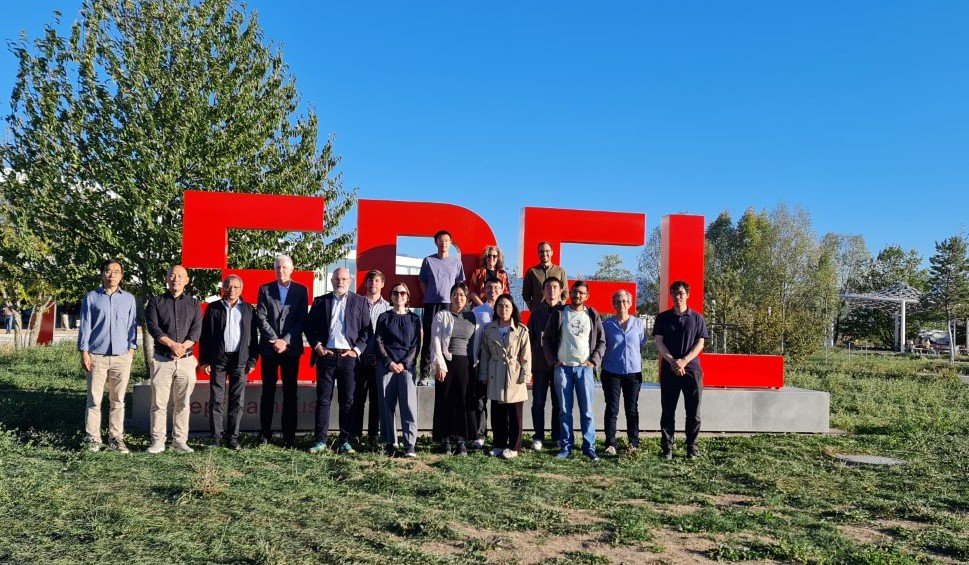
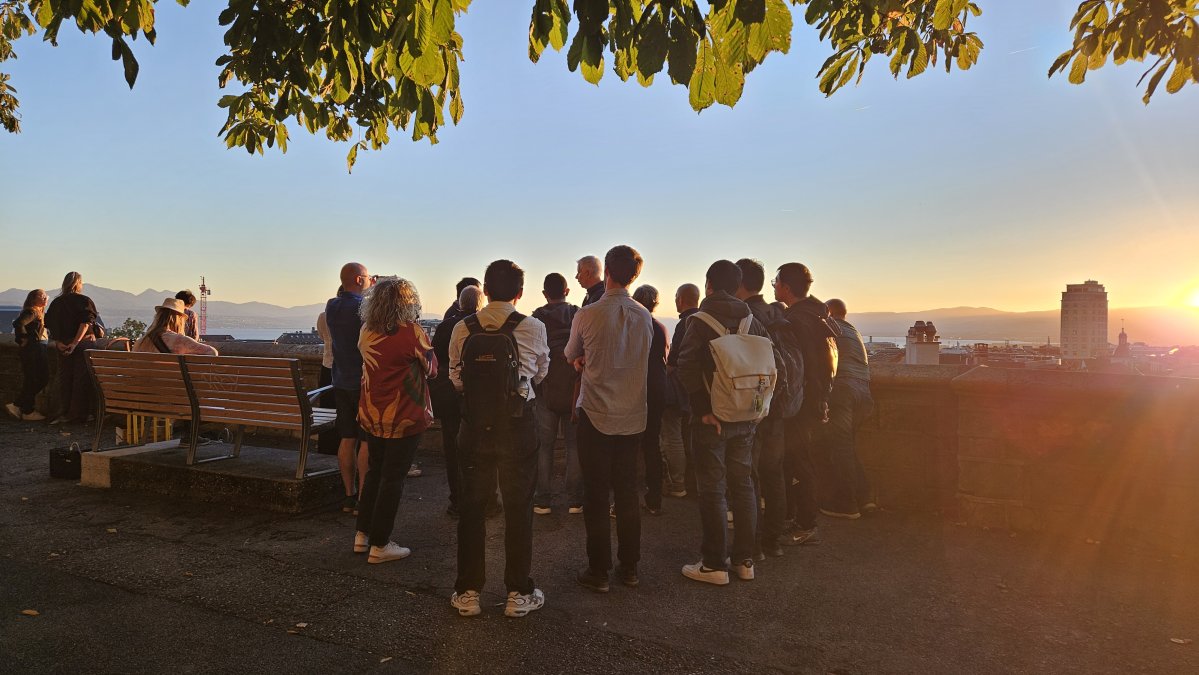
On 21–22 September 2026, the SUPERLASER consortium gathered in Lausanne, Switzerland, for its second annual progress meeting. Hosted by project partner EPFL, the two-day meeting provided an opportunity to review the scientific and technical achievements of the project's second year, exchange insights across the different work packages, and coordinate the next steps towards SUPERLASER's ambitious objectives.
With several important milestones reached the consortium reflected on the progress made so far and discussed the recently awarded EIC Booster Grant for CHIRAL-STEP, a joint initiative with the RADIANT project that will explore new applications of chiral perovskite materials in photodetectors. Learn more about CHIRAL-STEP here.
Scientific Updates
The meeting highlighted encouraging developments across the project's research activities:
• Computational materials screening: An advanced computational model was used to screen one million perovskite compositions, identifying promising candidates for further investigation, including materials with favourable spin-orbit coupling properties.
• Development of charge-transport materials: Newly developed electron- and hole-transport materials show promising results in perovskite light-emitting diodes (PeLEDs). Further characterisation and device integration will be pursued through close collaboration between project partners.
• Advances in perovskite superlattices: Encouraging progress was achieved in fabricating 3D and 3D/2D perovskite superlattices, alongside improvements in thin-film processing and the exploration of additives to enhance material and device performance.
• Optical characterisation of perovskite crystals: Promising results from low-temperature photoluminescence measurements provide new insights into perovskite single crystals. Further investigations will focus on validating optical coherence and cooperative emission phenomena.
• Progress towards perovskite lasers: Room-temperature optically pumped amplified spontaneous emission (ASE)/lasing was demonstrated in SUPERLASER resonators, alongside encouraging results in electrically assisted optical pumping, marking important steps towards the project's laser development objectives.
Beyond the scientific developments, partners reviewed ongoing sustainability assessments, including the environmental impacts of perovskite materials and devices, as well as communication, dissemination and exploitation activities. Updates on collaboration within the EIC Responsible Electronics (ReTronics) portfolio highlighted further opportunities for knowledge exchange and joint activities.
The meeting concluded with discussions on the priorities for the coming months, with a particular emphasis on strengthening collaboration between work packages and accelerating progress towards the project's remaining objectives.